Allergy immunotherapy for kids: shots, drops, or tablets?
For children with persistent allergic rhinitis, antihistamines and nasal sprays can control symptoms, but they do not change the immune system’s response to the allergen. Allergen immunotherapy is different.
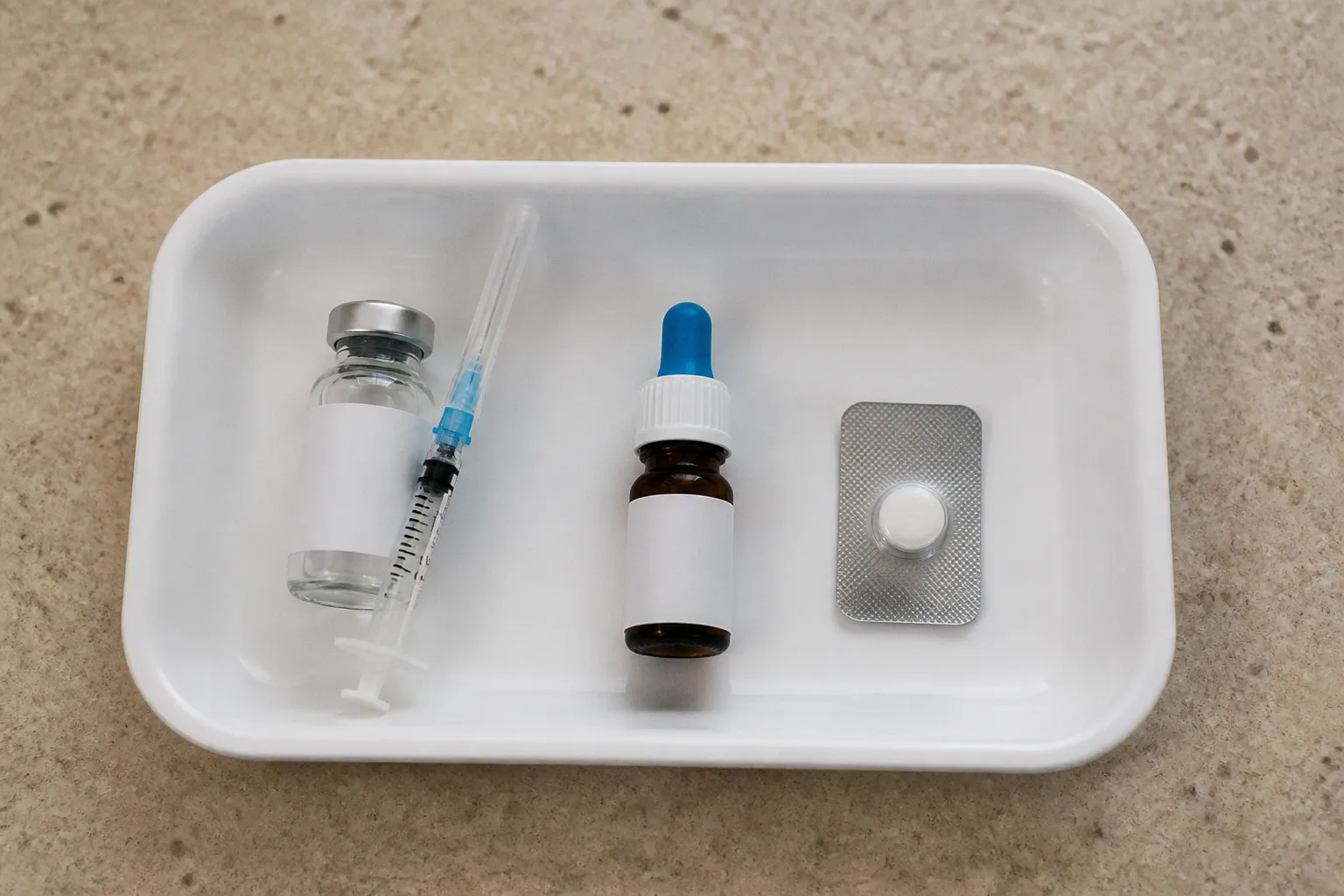
Over a planned course lasting roughly three to five years, the child receives carefully controlled exposure to the substance that triggers symptoms, with the goal of reducing reactivity that continues after treatment ends.
The practical choice is usually framed as shots versus drops or tablets. The more accurate comparison is between three distinct treatment pathways: subcutaneous immunotherapy (SCIT), FDA-approved sublingual immunotherapy tablets (SLIT), and liquid sublingual drops prepared and prescribed off-label. They share the broad goal of desensitization, but they do not have the same evidence base, regulatory status, dosing model, or safety infrastructure.
For families comparing pediatric allergy immunotherapy options, SCIT vs SLIT is therefore not a simple question of which route is “stronger.” The relevant questions are more specific: Which allergen needs to be treated? Is there an approved product for that allergen and the child’s age? Can the family manage daily treatment at home or repeated clinic visits? And what level of risk monitoring is appropriate?
The Mechanism of Desensitization: SCIT vs SLIT Immunology
SCIT and SLIT are not interchangeable versions of the same prescription. They expose the immune system to allergen through different routes and under different conditions. That affects how the treatment is administered, how quickly the dose can be increased, and which immune changes researchers can observe.
How SCIT changes the allergic response
With SCIT, an allergen extract is injected into subcutaneous tissue. The extract is taken up by local antigen-presenting cells and transported through the immune system, including the draining lymph nodes. Repeated exposure gradually changes the balance between inflammatory and regulatory responses.
One commonly measured feature of successful immunotherapy is an increase in allergen-specific IgG4. This antibody can compete with IgE for allergen binding. In simplified terms, it may intercept some of the allergen before it can cross-link IgE on mast cells and basophils, reducing the cascade that produces itching, sneezing, swelling, and other allergic symptoms.
SCIT is also associated with a shift away from a strongly Th2-dominated response. Th2 cells and their associated cytokines play a central role in allergic inflammation, so reducing that pattern is part of the broader process of immune tolerance. The change is not immediate, and IgG4 is not a standalone pass-or-fail test for an individual child. It is a research and monitoring marker that helps describe what is happening biologically during treatment.
SCIT can be built around a single allergen, such as a particular pollen, but it is not restricted to single-allergen treatment. In clinical practice, allergists may use extracts containing several relevant allergens when a child is sensitized to multiple substances and the treatment plan supports that approach. The composition depends on the child’s testing, symptom pattern, local exposure profile, extract compatibility, and the physician’s protocol.
That distinction matters. A child who reacts to several pollens is not automatically limited to one injection allergen. At the same time, a multi-allergen SCIT prescription is not simply equivalent to combining every positive test result. Sensitization on a skin or blood test does not always mean that each allergen is clinically important, and treatment decisions still require interpretation of the child’s history.
How SLIT uses the oral mucosa
Sublingual immunotherapy places the allergen under the tongue, where it contacts the oral mucosa before being swallowed. Local immune cells, including Langerhans cells, can capture the allergen and present it in a context that favors immune regulation rather than an escalating allergic response.
SLIT is often discussed in relation to regulatory T cells, or Tregs. These cells help suppress excessive immune activation and are associated with pathways involving cytokines such as IL-10 and TGF-β. SLIT may also produce changes in allergen-specific antibody responses, although the exact pattern and strength of these changes can vary by allergen, product, dose, and study design.
The route is local, but the intended effect is not confined to the mouth. With consistent dosing, the treatment aims to reduce the child’s clinical response when the same allergen is encountered in the nose, eyes, or lower airways. The oral route does not make SLIT risk-free, nor does it mean that every liquid or tablet product has the same pharmacologic profile.
In pediatric studies, SCIT and SLIT can both reduce allergic rhinitis symptoms and the need for rescue medication. Direct comparisons are difficult because trials may use different allergens, dosing schedules, outcome measures, and definitions of adherence. Claims that one route always produces a superior immune response are stronger than the evidence supports.
The meaningful comparison is not “injections versus a gentler version of injections.” SCIT and SLIT create different treatment systems, and the best fit depends on the allergen, the product, and the family’s ability to sustain the plan.
What the biomarkers can—and cannot—tell us
Immunotherapy research frequently measures IgE, IgG4, cytokine patterns, T-cell activity, and changes in inflammatory cells. These markers are useful for understanding the biology of desensitization, but they do not replace clinical outcomes.
A child may show an immunologic change without a dramatic improvement in every symptom. Conversely, symptom improvement may be meaningful even when a single biomarker does not change in the expected direction. In practice, the more relevant outcomes include:
- fewer days with nasal, ocular, or respiratory symptoms;
- less reliance on antihistamines or other allergy medicines;
- better sleep and school participation;
- reduced sensitivity during the relevant pollen or allergen season;
- persistence of benefit after treatment is stopped.
For this reason, biomarker kinetics should inform the clinical picture, not dominate it. A family does not choose SCIT because a laboratory marker sounds more sophisticated, or SLIT because its oral route sounds automatically safer. The treatment has to work in the child’s real environment.
Navigating FDA-Approved SLIT Tablets and Pediatric Age Ranges
In the United States, FDA-approved SLIT tablets provide a more standardized option than compounded liquid drops. The approved products are designed for specific allergens and age ranges. They are not interchangeable, and they do not cover every allergen that can be treated with SCIT.
The current pediatric options in the draft’s regulatory framework include four tablets:
| Tablet | Allergen | Approved pediatric use | Formulation scope |
|---|---|---|---|
| Grastek | Timothy grass pollen | Beginning at age 5 | Single allergen |
| Oralair | Five-grass pollen mix | Beginning at age 5 | Defined grass mix |
| Ragwitek | Short ragweed pollen | Beginning at age 5 | Single allergen |
| Odactra | House dust mite | Expanded to younger children within the 5–11 age range in February 2025 | Single allergen |
The important regulatory distinction is that FDA-approved SLIT tablets are made for a named single allergen or a defined grass mix. A five-grass tablet is a specific standardized mixture; it is not a general-purpose “pollen tablet” that covers every tree, weed, and grass pollen to which a child may test positive.
SCIT is broader in this respect. Depending on the clinical situation, it may use a single-allergen extract or a mixture of multiple allergen extracts. The fact that approved SLIT tablets are limited to certain single allergens or a defined grass mix does not mean that injection immunotherapy has the same limitation. It means that the regulatory and formulation rules are different for the two routes.
That difference can be decisive for a child with several clinically relevant sensitivities. A patient whose symptoms are driven by Timothy grass may be a straightforward candidate for a grass tablet if age and medical history are appropriate. A patient whose symptoms involve tree pollen, ragweed, dust mite, and animal dander may require a more individualized discussion. A tablet may address only one part of the exposure pattern, while SCIT may offer a physician-designed multi-allergen extract regimen when that is clinically justified.
What starting treatment involves
The first dose of an FDA-approved SLIT tablet is administered under medical supervision. The child is observed for an acute reaction, and the family receives instructions on continued dosing and emergency response. Subsequent doses are generally taken at home once the prescribing clinician has determined that home administration is appropriate.
The tablet is placed under the tongue and allowed to dissolve for the period specified by the product instructions before it is swallowed. The exact administration rules matter. A child may need to avoid food or drink around dosing, and the family needs a routine that makes missed doses less likely. Small children may also need close supervision to ensure that the tablet is used correctly rather than chewed, moved around the mouth, or discarded.
All approved tablets carry a boxed warning concerning severe allergic reactions. The requirement for access to epinephrine is therefore not a ceremonial part of the prescription. The family must know where the autoinjector is kept, how to recognize a concerning reaction, and when to use it and seek emergency care.
The tablet is not the same as food oral immunotherapy
The phrase “oral immunotherapy” is sometimes used broadly, but it can create confusion. Food oral immunotherapy involves measured ingestion of a food allergen, usually in the context of food allergy management. SLIT tablets involve allergen exposure through the sublingual route and are used for specific inhalant allergens such as grass pollen, ragweed, or house dust mite.
Both approaches involve controlled allergen exposure, but their products, indications, protocols, and safety discussions are not interchangeable. A parent asking about oral immunotherapy options for children should first clarify whether the concern is allergic rhinitis or a food allergy. The answer leads to a different clinical pathway.
The Reality of Liquid Allergy Drops and Off-Label Prescribing
Liquid allergy drops are often the option families hear about first because they appear flexible and convenient. In the United States, however, compounded liquid SLIT is not FDA-approved as a sublingual product. Allergists who prescribe it use allergen extracts that are commercially licensed for other purposes, including SCIT, and prescribe them off-label in liquid form.
That does not automatically make liquid drops ineffective or inappropriate. It does mean that the product should not be described as equivalent to an FDA-approved SLIT tablet. The evidence, manufacturing controls, dosing consistency, and insurance treatment are different.
Liquid preparations may be prescribed as a single allergen or as a multi-allergen mixture, depending on the clinic’s protocol. This flexibility can be attractive for polysensitized children, particularly when no approved tablet matches the clinically important allergen. It also introduces more variables:
- The concentration may vary by preparation. Compounded products are not subjected to the same FDA review for bioequivalence and standardized commercial dosing as approved tablets.
- The evidence is less uniform. Published studies of liquid SLIT do not all use the same extract concentration, dosing schedule, or patient selection, making results harder to compare.
- Insurance coverage is often limited or absent. Families may pay directly for the preparation and the associated clinical management.
- Home administration requires discipline. There may be no clinic visit attached to each dose, so missed doses and informal changes to the schedule can go unnoticed.
- The formulation can be customized, but customization is not the same as precision. Adding more allergens does not necessarily make a treatment more comprehensive or more effective.
The most important question is not whether a drop is “natural” or whether a tablet is “stronger.” It is whether the prescribed allergen, concentration, and schedule have a reasonable clinical rationale for that particular child.
Why multi-allergen treatment needs careful interpretation
Children frequently have more than one positive allergy test. That can make a multi-allergen drop regimen seem like the obvious solution. Yet a positive test indicates sensitization; it does not prove that every tested allergen is producing symptoms or that every allergen should be placed in the same preparation.
The allergist has to distinguish between:
1. allergens that consistently trigger symptoms;
2. allergens to which the child is sensitized but rarely exposed;
3. cross-reactive test results;
4. exposures that are clinically important but not suitable for the chosen formulation.
SCIT may also involve multiple allergen extracts, but it is not accurate to present multi-allergen treatment as a feature unique to liquid SLIT. The difference is that SCIT has an established injection-based framework for single- and multi-allergen extract regimens, while liquid SLIT remains an off-label approach with less standardized preparation and dosing.
For a child who cannot tolerate injections, a family that cannot manage frequent clinic visits, or a patient whose relevant allergen is not represented by an approved tablet, liquid SLIT may be discussed as one option. The off-label status should be part of that discussion, not hidden behind the language of convenience.
Clinical Safety Profiles and the Role of Epinephrine Autoinjectors
The phrase “allergy shots versus drops for kids” often implies that one route is dangerous and the other is harmless. That is not a useful safety model. Both SCIT and SLIT can cause allergic reactions. Their safety profiles differ partly because the dose is delivered in a clinic in one case and at home in the other.
SCIT: supervised dosing with a clinic-based safety net
SCIT is administered by injection in a medical setting. During the build-up phase, the dose increases gradually according to the prescribed schedule. Once the child reaches a maintenance dose, injections are given at longer intervals, often according to a regular maintenance cadence.
The clinic setting provides several layers of control:
- the extract is administered by trained staff;
- the child is observed after the injection;
- the next dose can be adjusted if the child is ill, has poorly controlled asthma, or has reacted to a previous injection;
- emergency medication and equipment are immediately available;
- the family does not have to decide at home whether a reaction is serious enough to treat.
A post-injection observation period is commonly used, often around 30 minutes, although the exact approach can depend on the clinic and the patient’s risk factors. Delayed reactions are possible, which is why families receive instructions about symptoms to watch for after leaving.
SCIT has a higher historical risk of systemic reactions than SLIT, including rare anaphylaxis. Risk assessment is especially important in children with asthma, a history of significant reactions, intercurrent illness, or difficulty communicating early symptoms. Poorly controlled asthma is a major concern because a systemic reaction may be more difficult to manage.
SLIT tablets: lower logistical burden, not zero risk
With an approved SLIT tablet, the first dose is given under supervision. Later doses are taken at home. Local reactions—such as oral itching, throat irritation, or itching in the ears—are common early in the course and often become less troublesome with continued treatment.
The home setting changes the safety equation. There is no professional observing every dose, so the child and caregiver must understand the difference between an expected local reaction and a potentially serious systemic reaction. The prescribing physician should provide specific instructions rather than relying on vague advice to “watch for symptoms.”
The FDA boxed warning for anaphylaxis applies to the approved tablets. Patients are prescribed an epinephrine autoinjector and should have it available whenever the treatment is taken, according to the clinician’s instructions. Families also need a plan for situations that may increase risk or complicate recognition of a reaction, including fever, acute illness, uncontrolled asthma, or a child who is too young to describe throat or breathing symptoms reliably.
Home administration is the logistical advantage of SLIT, not a guarantee of safety. The responsibility moves from the clinic to the household, so training and emergency planning become part of the treatment itself.
What families should be able to explain before starting
Before treatment begins, a caregiver should be able to describe:
- which allergen the therapy is intended to target;
- whether the product is FDA-approved for that use or prescribed off-label;
- where the first dose will be administered;
- how the child should take the dose;
- which symptoms are expected early local reactions;
- which symptoms require epinephrine and emergency evaluation;
- what to do after a missed dose;
- when treatment should be paused because of illness or another medical concern;
- how asthma control and other conditions affect the treatment decision.
This is not bureaucratic preparation. It is part of the clinical safety profile. A theoretically convenient treatment can become unsafe if the family is unclear about dosing, emergency medication, or when to contact the prescribing team.
Long-Term Commitment: Achieving Tolerance Over 3 to 5 Years
Allergen immunotherapy is a long-term intervention. The goal is not simply to make one pollen season easier. The intended benefit is a durable reduction in allergic reactivity that may persist after treatment is discontinued. In pediatric practice, treatment courses are commonly planned over three to five years, with progress reviewed along the way.
The immune system needs repeated exposure to consolidate the change. Over time, the treatment may involve altered antibody responses, greater regulatory activity, and less pronounced Th2-driven inflammation. These processes do not move in a straight line, and symptom improvement may occur before the deeper immunologic changes are fully established.
Stopping early can still leave a child feeling better, especially if the treatment overlaps with a favorable season or if avoidance measures have improved. That does not prove that durable tolerance has been achieved. Shorter courses may not provide the same lasting benefit as a completed multi-year course, and symptom recurrence after discontinuation is possible.
The adherence problem is different for each route
SCIT creates an external structure. The family must travel to the clinic, attend appointments, and maintain the schedule during both build-up and maintenance. That can be burdensome, but the same structure also provides reminders, dose documentation, and regular opportunities to reassess the child.
SLIT reduces travel but places more responsibility on the household. A daily tablet can be easier than a clinic visit, yet daily treatment over several years is not a small commitment. The dose may be missed during holidays, school trips, illness, or changes in custody and caregiving. For some children, the oral route is a major advantage. For others, the absence of an appointment makes it easier for treatment to fade into the background.
Liquid drops create a similar home-administration challenge, with the additional complication that the formulation may be off-label and less standardized. The family should know how the product is stored, how the dose is measured, and how the clinic handles missed doses or changes in the preparation.
Adherence should be discussed before the prescription is written, not after the first several months. A treatment that is theoretically well matched to the child’s allergy but repeatedly interrupted may produce less benefit than a less convenient option that the family can reliably complete.
When treatment is reassessed
Immunotherapy is not a contract that cannot be revisited. The prescribing allergist may reassess the plan if:
- symptoms are not improving despite consistent dosing;
- the child is having reactions;
- asthma control changes;
- the allergen exposure pattern changes;
- the child’s ability to cooperate with injections or home dosing changes;
- the family cannot sustain the schedule or cost;
- new evidence or an approved product changes the available options.
The absence of dramatic improvement in the first few weeks is not necessarily a reason to stop. Conversely, persistent poor adherence or repeated safety problems should not be dismissed as a normal part of the process. The course needs active clinical oversight even when most doses are taken at home.
Choosing Among Shots, Tablets, and Drops
The strongest choice is usually the one that aligns three elements: the clinically relevant allergen, the evidence and regulatory status of the product, and the family’s ability to maintain treatment safely.
When SCIT may be the better fit
SCIT may be considered when:
- the child’s key allergen is not covered by an approved SLIT tablet;
- several clinically relevant allergens need to be addressed in one treatment plan;
- a single-allergen or multi-allergen extract regimen is appropriate;
- the family can reliably attend clinic appointments;
- the child can tolerate injections and the post-injection observation routine;
- the physician believes the potential benefit justifies the clinic-based treatment burden.
SCIT is not automatically the most comprehensive option simply because it can include multiple extracts. The treatment still needs to be constructed around meaningful exposures rather than every positive test. But its ability to use individualized single- or multi-allergen extract regimens gives it a breadth that approved tablets do not currently offer.
When an approved SLIT tablet may be the better fit
An approved tablet may suit a child when:
- the main clinically relevant allergen matches the tablet indication;
- the child meets the product’s age requirements;
- the family can manage daily home dosing;
- the child can cooperate with sublingual administration;
- an epinephrine autoinjector is available and caregivers understand its use;
- avoiding regular injection visits would make completion more likely.
The tablet’s standardized formulation and FDA review provide a different level of product consistency from compounded liquid drops. That does not erase the boxed warning or make the treatment appropriate for every child. It means the family and clinician are working within a defined product and evidence framework.
When liquid drops may enter the discussion
Off-label liquid SLIT may be discussed when the child’s allergen profile does not fit an approved tablet, when a physician considers a multi-allergen preparation clinically reasonable, or when injections are not acceptable or feasible. The family should understand that flexibility comes with trade-offs involving evidence, standardization, cost, and regulatory status.
It is also worth asking what the drops are intended to accomplish. If the preparation contains a long list of allergens, the clinician should be able to explain why each one is included and how progress will be judged. “More allergens” is not automatically a more targeted or more effective treatment.
A comparison that reflects the real decision
| Consideration | SCIT | FDA-approved SLIT tablet | Liquid SLIT drops |
|---|---|---|---|
| Regulatory status | Established injection immunotherapy framework | FDA-approved for specific allergens and age ranges | Off-label in the United States |
| Allergen coverage | Single- or multi-allergen extracts may be used when clinically appropriate | Single allergen or a defined grass mix, depending on the product | Often customized; may be single- or multi-allergen |
| Administration | Injection in a clinic | First dose supervised, later doses at home | Usually home-administered after prescribing instructions |
| Monitoring burden | Repeated clinic visits and post-injection observation | Daily household administration and emergency preparedness | Daily household administration, with added formulation variability |
| Main practical advantage | Broad, individualized allergen planning | Standardized home dosing for approved indications | Flexibility when no approved tablet fits |
| Main practical limitation | Time, travel, injections, and systemic reaction risk | Narrower allergen indications and boxed warning | Less standardized evidence and frequent lack of insurance coverage |
This table should not be read as a ranking. It describes different compromises. A family with a child who reacts mainly to Timothy grass may reasonably prefer a tablet. A child with several important seasonal triggers may be better served by a carefully constructed SCIT plan. A child who does not fit either pathway may prompt a discussion of off-label drops, with the limitations made explicit.
The clinical endpoint is a child’s life, not a laboratory profile
The purpose of pediatric allergen immunotherapy is not to produce an impressive biomarker panel. It is to reduce the burden of allergy in a way that remains meaningful across school, sleep, sport, travel, and ordinary family life.
SCIT can use single- or multi-allergen extracts; approved SLIT tablets are limited to named single allergens or a defined grass mix; liquid SLIT occupies an off-label space with greater flexibility and less standardization. Those are not minor wording distinctions. They determine what can be prescribed, what evidence supports the prescription, how the treatment is delivered, and what the family must manage for years.
The right decision is therefore less about choosing the universally superior route than identifying the treatment the child can safely receive and the family can realistically sustain. The allergen match comes first. Regulatory status and evidence define the boundaries. Safety planning determines whether home treatment is appropriate. Adherence decides whether the theoretical benefit has a chance to become a durable clinical one.