MMR vaccine in DiGeorge syndrome: when is it safe?
A child with a 22q11.2 deletion may be listed in the chart as having DiGeorge syndrome, but that label does not answer the MMR question.
The clinically important distinction is whether the child has partial DiGeorge syndrome with measurable, functioning T-cell immunity or complete thymic aplasia with profound T-cell deficiency.
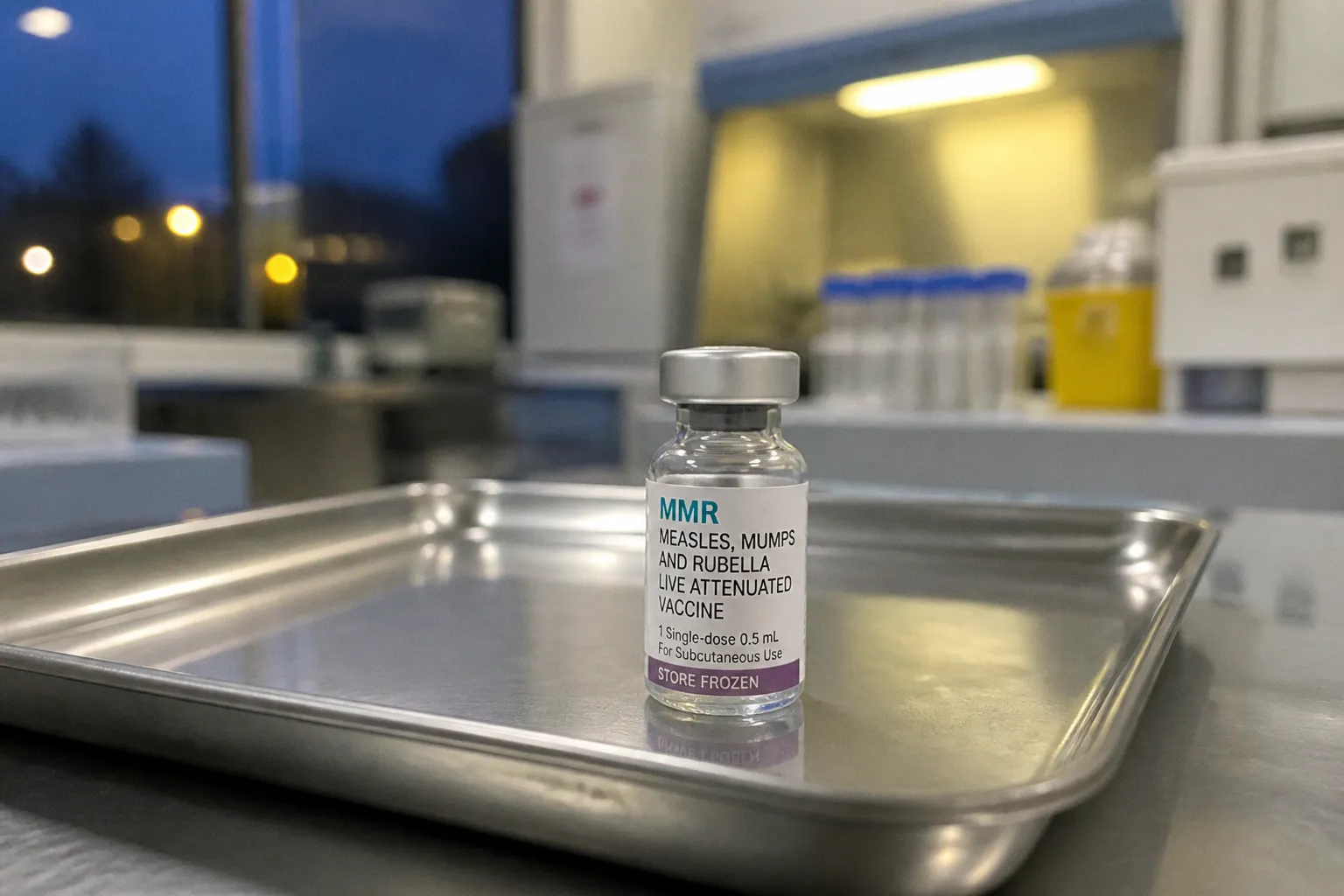
That distinction matters because MMR is a live attenuated vaccine. In a child with adequate cellular immunity, withholding it can leave a preventable gap in protection against measles, mumps, and rubella. In a child with severe T-cell dysfunction, the same vaccine may carry an unacceptable risk. The diagnosis opens the discussion; the immune phenotype determines where it goes.
This is a question about thresholds, but not thresholds in isolation. Absolute T-cell counts, the proportion of naive T cells, functional testing, clinical history, and the stability of the immune profile all have a role. A single diagnostic code is not enough evidence for either vaccination or permanent exclusion.
The Immunological Spectrum of 22q11.2 Deletion Syndrome
DiGeorge syndrome is not one immunological condition. The 22q11.2 deletion can affect thymic development to very different degrees, producing a spectrum that ranges from nearly normal T-cell production to complete thymic aplasia.
In partial DiGeorge syndrome, the thymus is usually hypoplastic rather than entirely absent. T-cell production may be reduced, but it is often sufficient to support routine immune functions, including an appropriate response to selected live vaccines. Some children have relatively modest abnormalities that become less prominent with age. Others have persistent lymphopenia, reduced naive T-cell output, impaired proliferation, or a combination of these findings.
Complete DiGeorge syndrome is a different clinical category. When thymic tissue is absent or functionally incapable of supporting T-cell development, the resulting cellular immunodeficiency can be profound. These children require specialist management from the outset, and treatment may involve thymic transplantation or hematopoietic stem cell transplantation depending on the wider clinical picture. MMR is not approached as part of an ordinary vaccination schedule until immune reconstitution has been demonstrated.
The difficulty in everyday practice is that the same 22q11.2 deletion diagnosis can appear in records belonging to children at opposite ends of this spectrum. A blanket rule that prohibits all live vaccines is too broad for some children with partial disease. A blanket assumption that every child with partial disease can receive MMR is equally unsafe.
The relevant questions are more specific:
- How many T cells are present?
- Are CD4 and CD8 populations above the accepted safety thresholds?
- Are the T cells functionally responsive to mitogens?
- Is there evidence of ongoing or severe opportunistic infection?
- Has the immune profile been stable, or is it changing?
- Has the child undergone transplantation or another treatment that changes the vaccination assessment?
The 22q11.2 deletion does not decide the MMR question by itself. The child’s measurable T-cell function does.
The risk calculation also runs in both directions. A child who is unable to receive MMR remains vulnerable to measles, and measles itself can be particularly dangerous in children with underlying immune dysfunction. That does not justify vaccinating below the safety boundary. It does explain why the decision should be individualized by a pediatric immunologist rather than left to an automatic live-vaccine prohibition.
Defining the Safety Thresholds: CD3, CD4, and CD8 Requirements
For partial DiGeorge syndrome, the commonly used laboratory framework considers three major T-cell subsets. The numbers describe different parts of the cellular immune system and should not be treated as interchangeable.
| T-cell subset | Common minimum threshold used in live-vaccine assessment | What it represents |
|---|---|---|
| CD3+ total T cells | ≥ 500 cells/mm³ | The overall circulating T-cell population |
| CD4+ helper T cells | ≥ 400 cells/mm³, or ≥ 0.4 × 10⁹/L | A major coordinating population within cellular immunity |
| CD8+ cytotoxic T cells | ≥ 200 cells/mm³, or ≥ 0.2 × 10⁹/L | A population involved in antiviral cellular responses |
These thresholds are commonly cited in pediatric immunology guidance for considering live vaccines in children with 22q11.2 deletion syndrome. They are safety floors, not targets that can be negotiated downward because another result looks reassuring.
A child who meets all three thresholds is in a substantially different position from a child who falls below one of them. In particular, a CD3 count below 500 cells/mm³ should not be described as clearing the basic quantitative threshold simply because the mitogen response is strong. Functional testing adds information; it does not erase a documented count below the stated safety floor.
The same principle applies in the other direction. A count above the threshold does not automatically establish that MMR is appropriate. The result must be interpreted alongside the child’s clinical history, age, laboratory trends, and functional immune testing.
Why one number is never enough
Absolute lymphocyte counts can vary with age, recent infection, steroid exposure, laboratory method, and ordinary biological fluctuation. A result that appears borderline should therefore be interpreted in context rather than treated as a permanent label. Repeat testing may be appropriate when the clinical picture and the laboratory result do not align.
The clinician also needs to distinguish absolute counts from percentages. A normal percentage of CD3+ cells does not compensate for a low absolute lymphocyte count. Conversely, an absolute count should not be read without considering whether the reported value is appropriate for the child’s age and whether it is stable over time.
The practical assessment usually includes:
- A current complete blood count with differential.
- Absolute CD3, CD4, and CD8 counts.
- Consideration of naive and memory T-cell populations when the phenotype is unclear.
- A review of serious, recurrent, or unusual infections.
- Functional T-cell testing when indicated.
- Confirmation that there is no transplant-related or treatment-related contraindication.
The decision is not a contest between the most reassuring result and the most concerning result. It is an attempt to determine whether the child has enough functioning cellular immunity to handle a live attenuated vaccine safely.
The significance of a stable trajectory
A single laboratory panel can be misleading. In a young child, the immune system is changing rapidly, and the absolute values need to be read against age-specific expectations. A stable or improving pattern is generally more reassuring than a falling count, even when both results are technically above a threshold.
That is why a current panel matters. An old result obtained before a significant infection, surgery, treatment change, or clinical deterioration may no longer represent the child’s present immune status. The time between testing and vaccination should be determined by the treating immunologist, especially when counts are close to the minimum.
Beyond Counts: The Role of Mitogen Proliferation Assays
Lymphocyte subset testing tells us how many T cells are circulating. It does not fully establish whether those cells can respond when challenged. Mitogen proliferation assays address that functional question.
Mitogens such as phytohemagglutinin, concanavalin A, and, in some laboratories, pokeweed mitogen are used to stimulate lymphocytes in vitro. The assay then measures the degree of proliferation. A preserved response suggests that the circulating T cells can activate and divide in response to a broad stimulus. A profoundly impaired response raises concern that the numerical count overstates the child’s effective cellular immunity.
This distinction is central to live-vaccine assessment. MMR contains attenuated viruses that are designed to replicate enough to stimulate an immune response. A child with a very low or absent functional T-cell response may be unable to control that replication normally, even if the absolute lymphocyte count looks less alarming than expected.
A robust mitogen response is therefore an important part of a reassuring evaluation, particularly when the clinical history or subset profile is complicated. It is not, however, a substitute for the quantitative thresholds. A child with CD3 below 500 cells/mm³ remains below the commonly used CD3 safety floor, even when functional testing is reassuring. The appropriate response is specialist review and, when necessary, repeat or expanded testing—not an informal exception to the threshold.
The reverse situation is also important. A child may have CD3, CD4, and CD8 counts above the numerical cutoffs but show impaired proliferation. That child should not be treated as automatically cleared. The functional result changes the risk assessment and may lead to postponement, additional investigation, or a decision to avoid live vaccination.
What the assay can and cannot tell you
Mitogen proliferation is a broad functional test. It does not reproduce the full immune response to measles, mumps, or rubella, and it does not guarantee that vaccination will produce durable protective antibody. It is best understood as evidence about general T-cell activation capacity, not as a direct MMR efficacy test.
The result also needs laboratory-specific interpretation. Different laboratories use different methods, controls, reporting units, and reference ranges. A report that says the response is reduced should not be translated into a vaccination decision without discussion with the immunologist who knows the assay and the child’s wider history.
For the same reason, normal proliferation does not make every live vaccine interchangeable. Vaccine type, route, the child’s immune defect, and the possibility of exposure all matter. MMR is often considered separately from vaccines such as live varicella vaccine, which may present a different risk profile and may require a different level of evidence before administration.
Clinical Evidence on Adverse Event Rates in Partial DiGeorge Patients
The evidence supporting MMR use in partial DiGeorge syndrome is reassuring but limited. It comes primarily from observational cohorts rather than randomized trials, and the cohorts should be read separately. Their denominators, methods, and reported outcomes are not interchangeable.
One report by Perez and colleagues included 59 patients with 22q11.2 deletion syndrome. Of those patients, 52 received MMR vaccination. Adverse events were documented in 23% of the vaccinated group, with reports characterized mainly by low-grade fever or transient rash. The study reported no severe reactions and no cases of disseminated vaccine-acquired disease in that vaccinated cohort.
A separate study by Hofstetter and colleagues examined 194 patients with DiGeorge syndrome. It reported adverse events at approximately 14% per dose, with events described as predominantly minor and self-limited. The dataset also reported zero post-vaccination deaths. That finding is important, but it should remain attached to the cohort in which it was observed; it should not be merged with the Perez cohort to create a larger implied vaccination denominator.
These studies provide useful safety signals, but they do not prove that MMR is safe for every child with a 22q11.2 deletion. Children with the most severe cellular immune defects are unlikely to be vaccinated in routine practice, so observational data are shaped by clinical selection. The patients who received MMR were generally those whom clinicians considered sufficiently immunologically capable of receiving it.
That selection is not a flaw in the studies. It is a reminder about what the evidence actually supports. The data are most relevant to children with partial DiGeorge syndrome who have undergone an appropriate immune evaluation. They do not justify vaccinating a child who falls below the quantitative thresholds or has severely impaired T-cell function.
The safety signal comes from immunologically selected patients, not from the diagnosis alone.
The adverse events described in these cohorts also need to be interpreted correctly. Fever and rash after MMR are expected forms of vaccine reactogenicity and do not, by themselves, indicate vaccine-acquired disease. A severe or prolonged illness, respiratory deterioration, persistent fever, or other concerning symptom after vaccination requires clinical assessment, particularly in a child with an underlying immune disorder. But the presence of a mild expected reaction should not be misclassified as evidence that the vaccine was unsafe.
At the same time, reassuring cohort data should not be inflated into a claim of zero serious events across all available vaccinations. The Perez study reports on 52 vaccinated patients. The Hofstetter study reports on 194 patients and predominantly minor events, with zero deaths in that dataset. Those are separate observations. They should not be presented as nearly 250 documented vaccinations, nor as proof that severe events were absent across a combined population.
What these studies do not establish
The available evidence does not define a precise biological point at which risk becomes zero. No threshold can do that. It establishes a practical boundary used to identify children whose cellular immunity appears adequate for vaccination, supported by clinical observation and expert guidance.
The studies also do not answer every question about long-term protection. Safety and immunogenicity are related but distinct. A child may tolerate MMR without a serious adverse event and still require consideration of whether the antibody response was adequate or durable. That question becomes more relevant if the child has persistent immune abnormalities, an unexpectedly poor vaccine response, or later exposure to measles.
For families, this distinction can be difficult. The decision is not simply whether the vaccine is safe or unsafe in the abstract. It is whether the child’s current immune profile places them in the group for whom the available safety evidence is applicable.
Navigating Contraindications in Complete Thymic Aplasia
Complete thymic aplasia changes the decision from a threshold assessment to a contraindication assessment. These children may have profound T-cell deficiency, very low CD3 counts, severely reduced or absent naive T-cell populations, and little or no effective thymic output.
In that setting, live attenuated vaccines such as MMR are generally contraindicated. The concern is not merely a lower chance of mounting a good antibody response. The more serious concern is inadequate cellular control of the attenuated vaccine virus. A child with severe T-cell dysfunction may be unable to contain replication in the way an immunocompetent child does.
The management pathway for complete DiGeorge syndrome focuses first on restoring or replacing T-cell immunity. Depending on the individual case, this may involve thymic transplantation, hematopoietic stem cell transplantation, or other specialist treatment. MMR is not simply delayed until a convenient future appointment. It remains off the table until the treating team has documented sufficient immune reconstitution and confirmed that vaccination is appropriate after the relevant intervention.
The post-transplant question is also individualized. The timing of live vaccination depends on the type of transplant, immune recovery, ongoing immunosuppression, graft function, and the recommendations of the transplant and immunology teams. A calendar-based approach is not adequate for a child whose immune system has been rebuilt or remains medically suppressed.
The danger of treating all 22q11.2 deletion patients alike
Over-caution and under-caution can both cause harm.
A universal prohibition may leave a child with partial DiGeorge syndrome unprotected against measles despite adequate T-cell numbers and function. That is not a neutral choice, because measles can cause severe disease and can further disrupt immune memory. On the other hand, applying the partial-DiGeorge pathway to a child with complete thymic aplasia ignores the very reason live vaccines are restricted in severe cellular immunodeficiency.
The correct dividing line is not the name in the problem list. It is the documented immune phenotype.
Other clinical details may also modify the decision:
- A history of serious opportunistic infections may indicate greater functional impairment than the basic subset panel suggests.
- Ongoing systemic immunosuppressive therapy may create an independent contraindication.
- Recent transplantation requires coordination with the transplant team.
- A rapidly changing or declining T-cell count warrants reassessment before vaccination.
- Maternal antibody, age, prior vaccination, and local outbreak conditions may affect timing without replacing the immune assessment.
- Household contacts should be appropriately immunized when possible, because cocooning reduces the child’s exposure risk while the decision is being made.
Bringing the Laboratory Data Into a Clinical Decision
A safe MMR decision in partial DiGeorge syndrome is not made by reading one line on a laboratory report. It is made by matching the child’s current immune data to the population represented in the safety evidence.
A practical review proceeds in a logical order:
1. Confirm the phenotype. The clinician should establish whether the child has partial disease, complete thymic aplasia, a post-transplant state, or another immune condition that changes the assessment.
2. Review current quantitative counts. CD3 should be at or above 500 cells/mm³, CD4 at or above 400 cells/mm³, and CD8 at or above 200 cells/mm³ under the commonly used framework. Borderline or unexpected results may require repeat testing.
3. Assess function. Mitogen proliferation testing can show whether the circulating T cells respond adequately to stimulation. A reassuring response supports the evaluation but does not override a count below the stated floor.
4. Check the clinical history. Severe, persistent, or unusual infections may be more informative than a superficially reassuring number. The absence of such infections is helpful, but it is not a replacement for laboratory assessment.
5. Consider treatment and timing. Immunosuppression, transplantation, recent illness, and changes in immune status may require the vaccination to be postponed or reassessed.
6. Document the decision. The record should show the relevant counts, functional results, clinical reasoning, and the name of the immunologist or specialist responsible for clearance.
This approach avoids two common errors. The first is treating the word DiGeorge as an automatic contraindication. The second is treating a single adequate count as automatic permission. Neither reflects how the immune system works.
Antibody response is a separate question
A child may be an appropriate candidate for MMR from a safety perspective and still have an uncertain vaccine response. T-cell function contributes to the development of durable antibody, but the relationship is not perfectly predictable from the subset count alone.
For that reason, some children may need later serological assessment, particularly when the immune phenotype remains abnormal or when there is a clinical reason to question vaccine response. Serology should be ordered and interpreted in context. It is not necessary to turn every vaccination into an open-ended testing program, but it is reasonable to recognize that safety and long-term protection are separate endpoints.
The existing observational cohorts primarily inform adverse-event risk. They do not establish lifelong persistence of protective measles antibody in every person with partial DiGeorge syndrome. That is an evidence gap, not a reason to withhold MMR from a child who meets the immunological criteria.
Where the Decision Lands
MMR vaccination can be appropriate for a child with partial DiGeorge syndrome when the immune evaluation shows adequate cellular immunity. The commonly used safety framework requires CD3 of at least 500 cells/mm³, CD4 of at least 400 cells/mm³, and CD8 of at least 200 cells/mm³, together with a reassuring assessment of T-cell function and no overriding clinical contraindication.
A mitogen response is valuable because it shows whether the T cells can respond, not merely whether they are present. But it is not a license to clear a child below the CD3, CD4, or CD8 safety floors. A result below the threshold should lead to specialist reassessment, not an unsupported exception.
The clinical evidence is encouraging within its limits. In the Perez cohort, 52 of 59 patients received MMR, and 23% of vaccinated patients had reported adverse events, mainly low-grade fever or transient rash; no severe reactions or disseminated vaccine-acquired disease were reported in that group. The separate Hofstetter cohort included 194 patients, with adverse events reported at approximately 14% per dose, predominantly minor and self-limiting, and zero post-vaccination deaths in that dataset. These findings should remain separate. They support a reassuring signal in appropriately selected patients, not a combined total of vaccinations or a universal guarantee of safety.
For complete DiGeorge syndrome with thymic aplasia, MMR remains contraindicated until immune reconstitution has been demonstrated and the treating specialists agree that live vaccination is safe. The diagnostic label is too broad to make the decision. The phenotype, the numbers, the functional assay, and the clinical context are what make the decision.